
Every other honey on Melvea is named for a plant. Wildflower is named for a place and a moment: whatever was blooming within reach of the hive, mixed by the bees in proportions nobody chose. No two jars are the same, and that is the point.
Updated
Wildflower's plaid. It has no single color, so the ground is plain straw. The lines are floral, fruity and herbaceous, the flavors that lead it.
A honey without a single flower behind it.
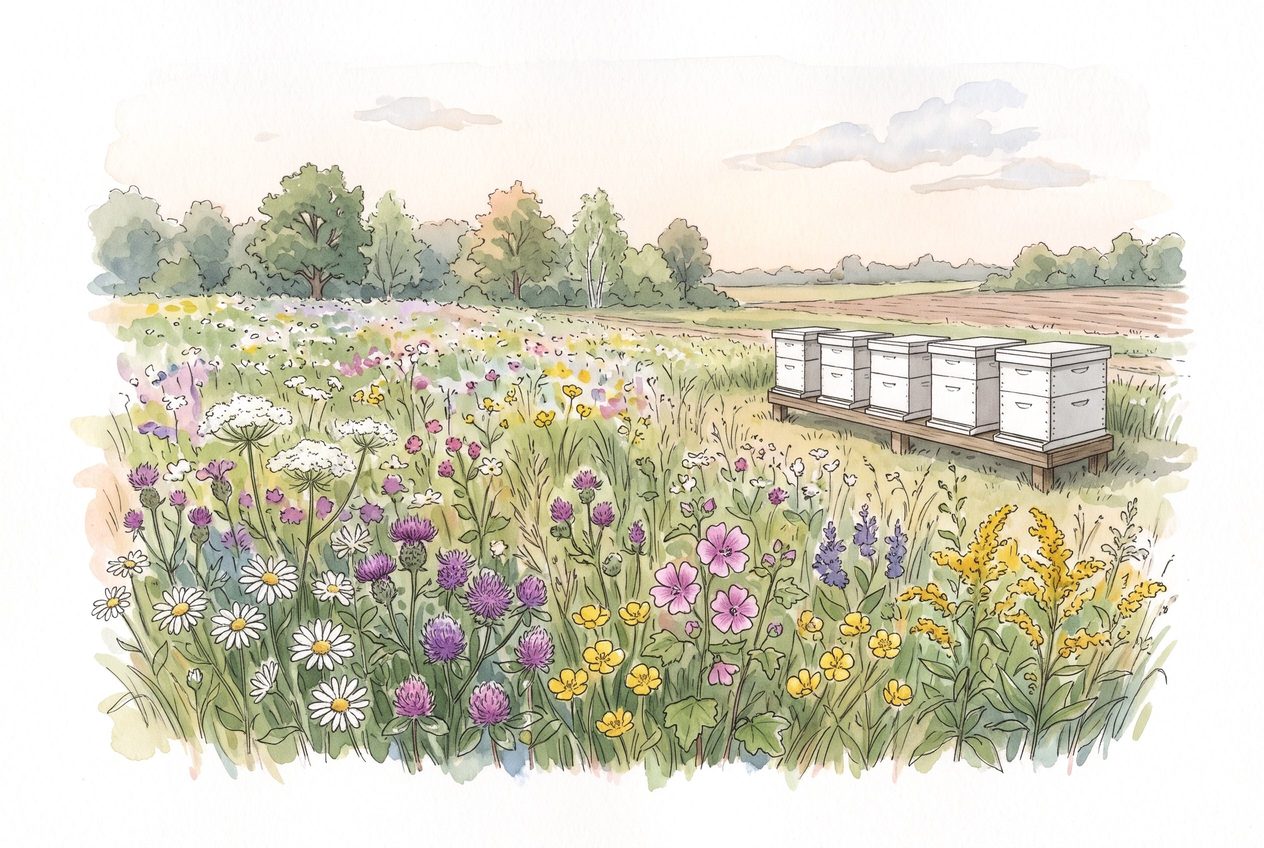
The National Honey Board describes wildflower honey as honey from miscellaneous and undefined flower sources.1 It is the honey of a meadow, a hedgerow or a hillside rather than of one crop or tree.
In the United States, a label does not have to name a flower at all. A producer may name one when there is information showing it is the chief floral source, and the FDA lists "Wild Flower Honey" among acceptable names, alongside orange blossom and clover. Whatever the label says has to be truthful and not misleading.2
Honey made from many different flowers, with no single plant behind it. The National Honey Board describes it as honey from miscellaneous and undefined flower sources.
Keep asking Mel →Yes. The FDA lists "Wild Flower Honey" as an acceptable name, as long as the label is truthful.
Keep asking Mel →The size of the meadow changes with the season.
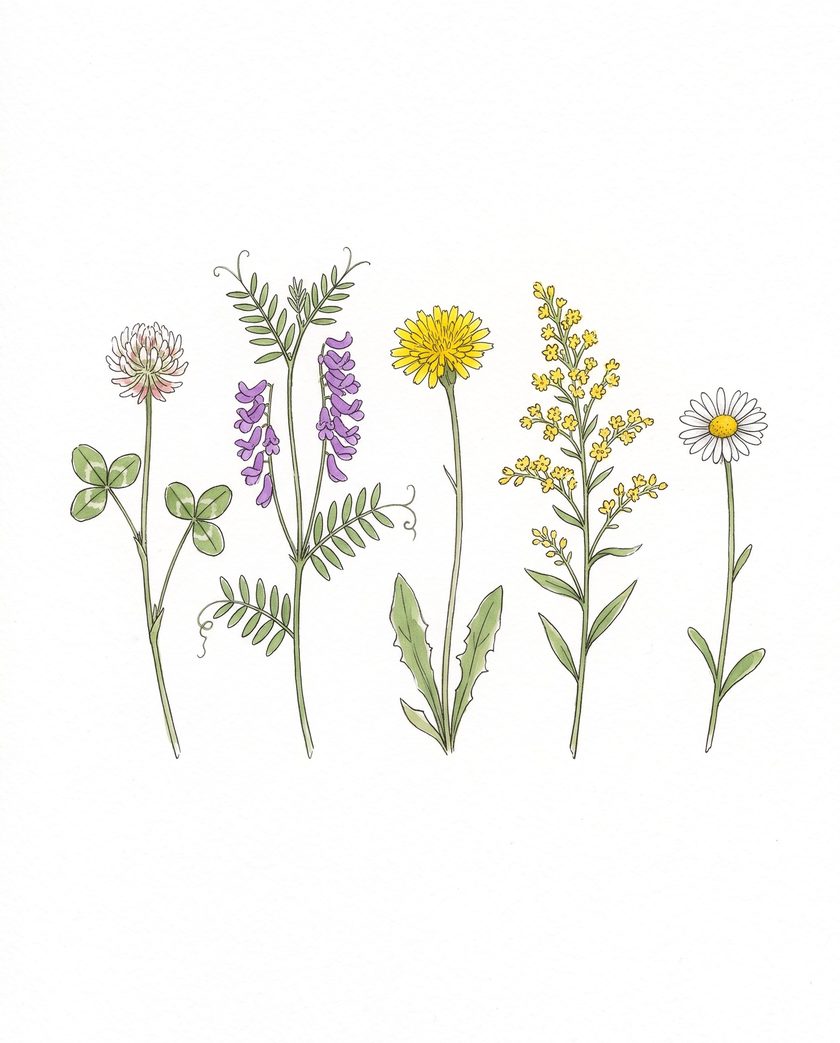
A honey bee that finds good flowers comes home and dances, and the dance tells its sisters how far away the flowers are. Researchers in England decoded 5,097 of those dances over two years to map where a colony was feeding.3
The answer changed with the season. In spring the bees fed close, on average about 493 meters from the hive. In summer they flew about 2,156 meters, working an area 22 times larger. In autumn they pulled back to about 1,275 meters.3
That is why a wildflower jar is a snapshot. A spring harvest draws on a small patch of countryside; a summer one can draw on fifteen square kilometers.3
It depends on the season. In one English study, average distances were about 493 meters in spring, about 2,156 meters in summer and about 1,275 meters in autumn.
Keep asking Mel →Because the bees work whatever is in bloom within reach, and both the flowers and the reach change through the year.
Keep asking Mel →Every spoonful carries a record of where the bees went.
Honey holds pollen, and pollen can be read. The first study of honey under the microscope dates to 1895. Today a lab counts at least 500 pollen grains, and a honey is credited to a single plant when that plant's pollen makes up more than 45 percent of the count.4 Some plants shed more pollen into honey than others, so the numbers need interpreting.4
Every spoonful carries a record of where the bees went.
A study in the Shimla hills of the Indian Himalaya shows how the seasons shape the result. Of 17 summer honeys, 12 had one dominant plant, including pear, apple and almond. Of 17 autumn honeys, only 6 did; the other 11 were mixed honeys, made from many flowers at once.5
By counting the pollen in it under a microscope. A honey is credited to one plant when that plant makes up more than 45 percent of the pollen counted.
Keep asking Mel →They describe the same idea: honey without one dominant flower. Scientists call it multifloral; shops usually say wildflower.
Keep asking Mel →A flavor that belongs to one place and one season.
The National Honey Board puts wildflower honey in the amber to dark amber range, with mild floral overtones, and calls it extremely versatile.1
Beyond that, it is honest to say it varies with the flowers in it. Melvea's palate below is a typical profile, not a promise.
Floral: the through-line across nearly every regional wildflower
Tap a family to read its note.
It varies by place and season. Typically it is amber, rounded and mildly floral.
Keep asking Mel →Because each comes from a different mix of flowers, gathered in a different place and season.
Keep asking Mel →Good at almost everything.
Wildflower honey is the generalist of the pantry. The National Honey Board suggests it for fruit and vegetable salad dressings, baked goods and the table.1
Wildflower + vinaigrette. Rounds out the acid.
In dressings, baking, tea and glazes. It is the everyday all-purpose honey.
Keep asking Mel →Yes. The National Honey Board lists baked goods among its uses.
Keep asking Mel →The label should tell you where, and ideally when.
Because wildflower honey is defined by place, the best labels name one: a county, a valley, a farm, a season. A jar that names nothing but "wildflower" could be from anywhere.
Below are the jars Melvea has been able to score.
As an Amazon Associate, Melvea earns from qualifying purchases.
Look for a named place and beekeeper, and ideally the season of harvest.
Keep asking Mel →Each jar gets one score built from three parts: flavor counts for 50%, origin for 30% and purity for 20%. The three bars on every jar card show how it did on each.
Keep asking Mel →Honey from many flowers, with no single plant behind it.
Keep asking Mel →The flowers in bloom, and how far the bees fly, change with place and season.
Keep asking Mel →Typically amber, rounded and mildly floral, but every jar is different.
Keep asking Mel →Each jar gets one score built from three parts: flavor counts for 50%, origin for 30% and purity for 20%.
Keep asking Mel →Honey made from many different flowers rather than one dominant source. The National Honey Board describes it as honey from miscellaneous and undefined flower sources.
It varies with place and season. Typically amber to dark amber with mild floral overtones.
Yes, in practice. All describe honey without one dominant floral source.
By pollen analysis. A honey is credited to one plant when that plant makes up more than 45 percent of the pollen counted.
Different flowers bloom through the year, and bees forage over very different distances in spring, summer and autumn.
Almost everything: dressings, baking, tea and the table.
Tasted a wildflower jar? Rate it in one tap.
Find your jar →Spotted in the wild
From shelves, kitchens, and markets. Add yours — we review every submission.
No photos yet.
Be the first to submit a photo of Wildflower honey— help build the encyclopedia.
Submit a Wildflowerphoto →Verified wildflower honey producers in our network.
Wewahitchka, Florida
L.L. Lanier & Sons Tupelo Honey is a fifth-generation family honey farm based in Wewahitchka, Florida, producing pure, r...
Clermont, Florida
Honey Feast is a family-owned apiary and farm based in Clermont, Central Florida, producing raw, unfiltered, and cold-pa...
Te Puke, Bay of Plenty
The world's largest Manuka honey company, founded in 1974. UMF-certified with full traceability from hive to shelf.
Lake Park, Georgia
Pure Southern Honey is a multi-generational, family-owned beekeeping operation based in South Georgia, producing 100% ra...
Baltimore, Maryland
Really Raw Honey is a Baltimore, Maryland-based company founded in 1982 that produces and sells totally unprocessed hone...
Portland, Oregon
Mickelberry Gardens is a Portland, Oregon-based honey and herbal wellness brand founded by husband-and-wife team Matt an...
Are you an wildflower beekeeper?
Claim Your Farm
