

A form, not a variety
Whipped honey
Honey that has been coaxed into setting on purpose, in crystals too fine to feel. It spreads like soft butter, and it is still only honey.
- What it is
- Honey set into very fine crystals
- Also called
- Creamed, spun, churned, honey fondant
- Patented
- January 15, 1935
Updated

- same honey, finer crystals
- spreads, does not drip
- the patent paid for a bee lab
Crystals too small to feel
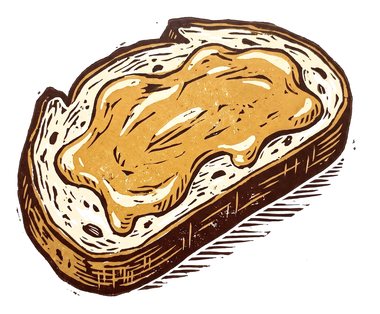
Nothing is whipped in. The difference between this jar and a runny one is the size of the crystals.
Left alone long enough, most honey turns solid. It is a solution holding more glucose than it can keep dissolved, so the glucose slowly comes out as crystals. How fast depends on the honey's balance of sugars, on what is floating in it and on how warm it is kept. A US government buying specification spells out the point shoppers most often get wrong: honey going grainy is not a sign that anything was added to it.1
Whipped honey is that same change, done deliberately and done well. The honey trade's own definition is one line long: honey processed by controlled crystallization to a smooth, spreadable consistency.2 Left to itself, honey tends to set coarse and gritty. Guided, it sets into crystals so fine the tongue reads them as cream.3
Guided, honey sets into crystals so fine the tongue reads them as cream.
So it is a form, not a variety, and the name on the lid is a matter of taste. The same definition treats creamed honey, spun honey, churned honey and honey fondant as other names for the one thing.2 American grade standards file all of them under a single type, crystallized honey, whether the jar says candied, fondant, creamed or spread.4
Honey that has been crystallized on purpose into very fine crystals, which makes it smooth and spreadable. It is the same thing as creamed or spun honey.
Keep asking Mel →No. The name describes the texture. The trade definition is honey processed by controlled crystallization, and honey by definition has nothing added.
Keep asking Mel →The patent that built a bee lab
The method most of the world still uses was written down by one man in 1931. Then he gave it away.
Elton James Dyce was born in 1900 in Meaford, Ontario, and taught beekeeping at the Ontario Agricultural College in Guelph from 1924 to 1940. He also took a doctorate at Cornell University, under the bee scientist E. F. Phillips.5 It was from Ithaca, New York, on March 26, 1931, that he filed a patent application titled "Honey process and product." It was granted on January 15, 1935.3
He was answering two complaints at once. Liquid honey, he wrote, was difficult to spread on bread or use at the table without dripping. Honey that had set on its own did not drip, but it was often coarse and gritty, and set honey was known for fermenting in the jar. He traced that last problem to yeasts.3
His answer was to stop leaving it to chance. Warm the honey enough to kill the yeasts and melt every stray crystal, cool it, stir in a little honey that is already finely set, and keep it cool while the whole batch follows that pattern. What came out, in his words, had a "smooth, firm, fondant-like consistency."3
Then he gave it away. Dyce handed the American patent rights to Cornell on one condition: whatever it earned had to be spent on research into bees and honey, and nothing else. In Canada the patent went to the Province of Ontario. Cornell's faculty later recorded that it earned more than any other patent the university had ever held.5
He gave the patent to Cornell on one condition: the money had to go to bees.
The money turned into bricks and books. It endowed a library of beekeeping books at Cornell, and in 1968 it built a laboratory near Varna, New York, given over entirely to the study of honey bees. The building was named for him.5 Dyce himself left Guelph in 1940, spent two years running a honey producers' cooperative in Groton, New York, and then joined the Cornell faculty, where he taught for twenty-three years before retiring at the end of 1965. By the time he died in 1976, his colleagues wrote, his process was in use in every major honey-producing country in the world.5
The standard method was patented by Elton James Dyce, an Ontario-born beekeeping teacher who took his doctorate at Cornell. He applied in 1931 and the patent was granted on January 15, 1935.
Keep asking Mel →Dyce gave the US rights to Cornell University on condition the money be used only for research on bees and honey. It paid for a beekeeping library and, in 1968, the Dyce Laboratory for honey bee studies.
Keep asking Mel →To fix two problems: liquid honey drips and is hard to spread, and honey that sets on its own is often gritty and could ferment.
Keep asking Mel →Three things people get wrong about whipped honey
Warm, seed, keep cool
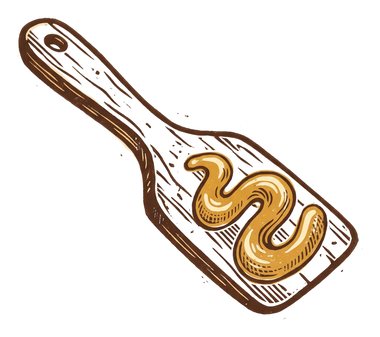
Three steps and three numbers, straight from the patent.
First the honey is heated to about 160°F (71°C), stirred all the while, then cooled quickly. That clears out the yeasts and any crystals already forming, so the batch starts from a blank page.3
Then comes the seed. At about 75°F (24°C), a small share of honey that has already been through the process is stirred in: about 5 percent by weight, with anything from 3 to 10 percent generally preferred. Those fine crystals are the pattern the rest will copy.3
Here is the surprise in the name. The patent tells the maker to mix for about fifteen minutes with the stirrer set low in the tank, well under the surface, so that it does not draw in air.3 Whipped honey, made the original way, is not whipped.
Last, the jars are filled and held at about 57°F (14°C), the temperature at which Dyce found crystals form fastest. He wanted it steady: a drift of two or three degrees, he wrote, could double the time. The aim was a batch set within three or four days, because slower setting gives coarser crystals.3 A US government specification from 2019 describes the same routine still in use: liquefy the honey, strain it, add seed crystals, pour it into jars and let them set in a cool room.1
By the patent's method: heat the honey to about 160°F and cool it, stir in about 5 percent of finely set honey as seed, then hold the jars at about 57°F until the batch sets.
Keep asking Mel →Not in the original method. The 1935 patent says to keep the stirrer low in the tank so that it does not draw air into the honey.
Keep asking Mel →What to look for
Read the name, then read the ingredients.
Whipped, creamed, spun, churned: on a label these mean the same thing, so choose by the honey inside, not by the word.2 The thing to check is the ingredient list. Honey, by the trade's definition, is a pure product with no other substance added. A honey spread is a different product: honey or creamed honey that may be blended with fruit, nuts, flavors or spices.2 Both can be good. They are not the same jar.
Do not expect a grade to tell you about texture. Under the US standards, crystallized honey is melted before it is graded, and smoothness is not one of the things scored.4 The only test is a knife.
Keep it somewhere cool. Dyce noted that the finished honey holds at ordinary room temperature, but that a thinner honey can turn liquid again if it is stored too warm.3
Browse Whipped honey
As an Amazon Associate, Melvea earns from qualifying purchases.
Creamed honey is only honey, set into fine crystals. A honey spread may have fruit, nuts, flavors or spices blended in. The ingredient list tells you which you have.
Keep asking Mel →Somewhere cool. The patent notes it holds at ordinary room temperature, but a thinner honey can turn liquid again if stored too warm.
Keep asking Mel →Still curious about whipped honey?
A small amount of honey that is already finely set, usually from an earlier batch. The patent calls for about 5 percent by weight. Its crystals are the pattern the rest of the batch copies.
Keep asking Mel →No. Under US standards crystallized honey is melted before grading, and texture is not scored.
Keep asking Mel →before you go
Questions people ask.
What is whipped honey?
Honey processed by controlled crystallization to a smooth, spreadable consistency. Nothing is added; the crystals are simply very fine.
Is whipped honey the same as creamed honey?
Yes. The National Honey Board treats creamed, spun and churned honey and honey fondant as other names for whipped honey.
Who invented it?
The standard method was patented by Elton James Dyce, born in Meaford, Ontario, in 1900: filed from Ithaca, New York, on March 26, 1931, and granted January 15, 1935. He gave the US patent rights to Cornell University to fund research on bees and honey.
Has honey that crystallizes been tampered with?
No. Honey holds more glucose than it can keep dissolved, so it crystallizes naturally. US government purchasing rules state that granulation is not an indicator of adulteration.
Can any honey be whipped?
It is a form, not a variety. The patent describes adjusting the setting temperature slightly for thinner and thicker honeys.
turn the page
Other honey styles.
That is the end of this page. Go and taste something.
Sources.
- 1USDA Agricultural Marketing Service. Commercial Item Description A-A-20380: Honey, October 23, 2019, sections 6.1.4 and 6.1.5. Open source
- 2National Honey Board. Definition of Honey and Honey Products. Approved June 15, 1996; updated September 27, 2003. Hosted copy. Open source
- 3Dyce EJ (1935). Honey process and product. United States Patent 1,987,893. Filed March 26, 1931; granted January 15, 1935. Open source
- 4USDA Agricultural Marketing Service. United States Standards for Grades of Extracted Honey, effective May 23, 1985, sections 52.1392 and 52.1401. Open source
- 5Coggshall WL, Pechuman LL, Morse RA (1976). Elton James Dyce, July 15, 1900 to February 23, 1976. Cornell University Faculty Memorial Statement. Open source