

A word on the label, not a variety
Raw honey
The most trusted word on a honey label, and one of the least defined. Here is what it means on paper, and what happened when one state tried to pin it to a number.
- The idea
- Taken from the comb, and little else
- World standard
- Never uses the word
- In Utah law
- Since 2011
Updated

- out of the comb, through a strainer
- no agreed number for "raw"
- Utah tried 118 degrees
What the word promises
Raw is a claim about what was not done.
Every other style on this shelf adds a step. Hot honey adds chilies, whipped honey adds a few days in a cool room. Raw is the opposite kind of word. It tells you what the honey was spared.
Raw is a claim about what was not done.
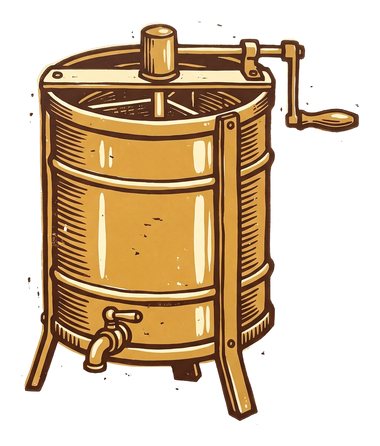
The honey trade wrote it down this way: raw honey is honey as it exists in the hive, or as obtained by extraction, settling or straining, without added heat.1 Spun out of the comb, left to settle, poured through a strainer, and that is all.
Then the same document adds a second entry, and it is the more revealing one. "Commercially raw honey" is honey obtained with minimum processing, and it notes that this is the product often labeled raw. How little counts as minimum is left to whoever is buying.1 So even the industry's own dictionary holds two meanings: the strict one, and the one on the shelf.
By the National Honey Board's definition, honey as it exists in the hive or as obtained by extraction, settling or straining, without added heat.
Keep asking Mel →The trade's term for honey obtained with minimum processing. The same definition notes it is often simply labeled raw, and leaves "minimum" to the buyer.
Keep asking Mel →The law that lost its number
In 2011 Utah set out to define raw honey by temperature. The number lasted about a week.
The bill was one page long. A state representative from Orem proposed that honey could be labeled raw in Utah only if it had never been pasteurized and never heated above 118 degrees Fahrenheit. Beekeepers in his district, he said, wanted to protect their place in the raw market.2
The objection came from inside the business. A Utah honey packer told a reporter that honey has to be warmed to get it out of the hive at all, that her own company steam-treated its honey before straining it, and that she still considered it raw. Her suggestion was to drop the number and write "minimally processed" instead. A spokesman for the state agriculture department added that producers heat honey to make it more customer-friendly, and that he doubted shoppers knew the difference.2
That story ran on February 22. On February 28 a House committee amended the bill, and the amended copy still shows the edit: the line about 118 degrees struck through, and "minimally processed" written in.3
The law Utah passed has three tests and no thermometer. Raw honey is honey as it exists in the beehive or as obtained by extraction, settling or straining; that is minimally processed; and that is not pasteurized. Honey sold in the state may be labeled raw only if it meets them.4
The law Utah passed has three tests and no thermometer.
Utah has one, passed in 2011: honey as it exists in the hive or obtained by extraction, settling or straining, that is minimally processed and not pasteurized.
Keep asking Mel →Not in Utah's law. The bill began with a limit of 118 degrees Fahrenheit, but it was struck out in committee and replaced with "minimally processed".
Keep asking Mel →Three things people get wrong about raw honey
Strained, not filtered
The clearest line anyone has drawn is about what passes through the mesh.
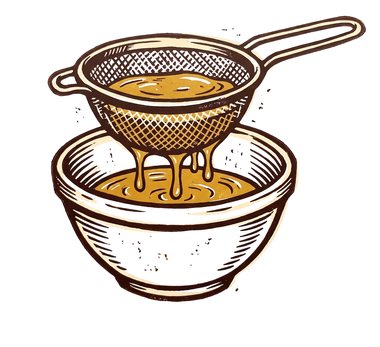
American grade standards sort honey into two styles by how it was cleaned. Strained honey has had the bits taken out: comb, propolis, the debris of the hive. Pollen grains, small air bubbles and very fine particles normally stay in. Filtered honey has had all or most of those fine particles removed as well, pollen included.5
Utah's rules use the same test to say what raw allows. Straining, they say, means passing honey through a screen or cloth with a mesh large enough to let pollen grains through.6
The world food standard never uses the word raw. What it has instead are rules for all honey. Pollen may not be removed, except where that cannot be avoided in taking out foreign matter. Honey may not be heated or processed until its essential composition changes or its quality suffers. And honey filtered so that its pollen is significantly removed has to be called filtered honey on the label.7
Strained honey has comb, propolis and debris removed, but pollen and very fine particles normally stay. Filtered honey has all or most of the fine particles removed, pollen included.
Keep asking Mel →Yes. Both the trade definition and Utah's law count straining as part of how raw honey is obtained. Utah defines it as a mesh large enough to let pollen grains through.
Keep asking Mel →What to look for
Since the word has no single meaning, ask what the seller means by it.
Two questions do most of the work. Was it heated, and how warm? Was it strained or filtered? A seller who uses the word carefully will have an answer to both. The definitions above are the measuring stick: no added heat is the strict reading, minimally processed is the loose one.1
Do not read a solid jar as a bad sign. Honey is a solution holding more glucose than it can keep, so it sets on its own, and a US government specification says outright that granulation is not an indicator of adulteration.8
And look for the word that has a rule behind it. Under the world standard, honey with its pollen filtered out has to say filtered.7 Raw is a promise. Filtered is a declaration.
Browse Raw honey
As an Amazon Associate, Melvea earns from qualifying purchases.
The label alone cannot tell you, because the word has more than one meaning. Ask the seller whether it was heated and whether it was strained or filtered.
Keep asking Mel →Yes. Honey sets naturally because it holds more glucose than it can keep dissolved. A US government specification states that granulation is not an indicator of adulteration.
Keep asking Mel →Still curious about raw honey?
A Utah packer said honey must be warmed to get it out of the hive, and the state agriculture department said producers heat it to make it more customer-friendly.
Keep asking Mel →It is honey as it exists in the hive, which is the first half of every definition of raw on this page. Nothing has been extracted or strained.
Keep asking Mel →before you go
Questions people ask.
What is raw honey?
In the National Honey Board's definition, honey as it exists in the hive or as obtained by extraction, settling or straining, without added heat.
Is raw honey a variety?
No. It is a word about handling. Any honey can be raw.
Is raw honey the same as unfiltered honey?
They overlap. Raw definitions allow straining, which leaves pollen in. Filtering removes all or most fine particles, pollen included.
Does the world honey standard define raw honey?
No. The Codex standard does not use the word. It sets rules for all honey on heating, pollen and the labeling of filtered honey.
Why did Utah drop the 118 degree rule?
After a packer objected that honey must be warmed to be extracted, a House committee struck the number and wrote in "minimally processed" on February 28, 2011.
turn the page
Other honey styles.
That is the end of this page. Go and taste something.
Sources.
- 1National Honey Board. Definition of Honey and Honey Products. Approved June 15, 1996; updated September 27, 2003. Hosted copy. Open source
- 2Verzello A (2011). Utah lawmaker wants to define raw honey. KSL.com, February 22, 2011. Open source
- 3State of Utah (2011). H.B. 148, Raw Honey Amendments, first substitute with House committee amendments of February 28, 2011. Open source
- 4State of Utah (2011). H.B. 148, Raw Honey Amendments, enrolled copy, enacting Utah Code section 4-5-20. Open source
- 5USDA Agricultural Marketing Service. United States Standards for Grades of Extracted Honey, effective May 23, 1985, section 52.1393. Open source
- 6Utah Administrative Code R70-520-2, Definitions (Standard of Identity and Labeling Requirements for Honey), as amended effective June 1, 2022. Open source
- 7Codex Alimentarius Commission. Revised Codex Standard for Honey, CODEX STAN 12-1981, Rev. 2 (2001), sections 3.1, 3.2 and 6.1.12. Open source
- 8USDA Agricultural Marketing Service. Commercial Item Description A-A-20380: Honey, October 23, 2019, section 6.1.4. Open source