

A form, not a variety
Comb honey
Honey still in the wax cells the bees built and sealed. For most of history this was simply what honey looked like; the jar of liquid came later.
- What it is
- Honey sold in its own sealed comb
- Section box
- California, 1857
- US standards
- Four kinds, graded on the comb
Updated

- sealed by the bees
- nothing done to it since
- how honey was sold, once
Honey with nothing done to it
Every other jar on the shelf has been taken out of something. This is the something.
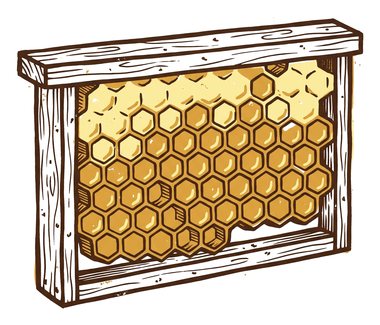
Bees do not make jars of honey. They make comb: sheets of six-sided wax cells, filled one by one and capped with more wax when the honey is ready. Comb honey is that, cut out and sold as it is. The world food standard defines it as honey stored by bees in the cells of freshly built combs with no brood in them, sold in sealed whole combs or sections of them.1
Bees do not make jars of honey. They make comb.
Ordinary honey is what you get by undoing the bees' work. The same standard lists three ways: spinning it out of combs whose caps have been cut off, pressing the combs, or letting them drain.1 Comb honey skips all three. Nobody has uncapped it, spun it, strained it or poured it.
That makes it a form, not a variety. Any honey can be comb honey, because every honey starts out in comb. The standard has a word for these ways of presenting honey, and it happens to be the one this shelf uses: styles.1
Honey still in the wax cells the bees built and capped, cut out and sold as it is. Nothing has been spun, pressed or strained out of it.
Keep asking Mel →No. It is a form. Any honey can be sold as comb, because every honey starts out in comb.
Keep asking Mel →When all honey came this way
Liquid honey in a jar is the newcomer. It is about 160 years old.
Before the 1860s, people bought their honey in the comb. That was simply the traditional way.2 In America much of it went to market as "box honey": small wooden boxes holding about five pounds, with a pane of glass in one end so the buyer could see inside. The beekeeper set the boxes above the hive, let the bees fill them, and sold them just as they came off.3
The neat square of comb that people picture today has an inventor and a birthday. J. S. Harbison, a California beekeeper, worked out what he called the "section honey-box" and, by his own account, perfected it on Christmas Day, 1857.3 Others spent the 1870s refining it, arguing over whether it should be exactly square, and the years from about 1876 to 1910 became the comb honey era, when most of the leading beekeepers produced it and the bee magazines talked of little else.3
What ended comb's monopoly was a machine. In the winter of 1864 to 1865 an Austrian officer, Major Franz von Hruschka, found that spinning a comb flings the honey out and leaves the wax whole, ready to go back in the hive and be filled again.2 Beekeepers loved it for that reason.
Buyers were slower. Honey in the comb had been built and sealed by bees, so it was taken as proof that nothing had been added. Liquid honey carried no such proof, and honest beekeepers selling it had to live down the suspicion that it had been stretched with cheap sugar until laws against that were passed.2
Honey in the comb had been sealed by bees, so it was taken as proof that nothing had been added.
J. S. Harbison of California. He called it the section honey-box and said he perfected it on December 25, 1857.
Keep asking Mel →Because bees had built and sealed it. When liquid honey arrived in the late 1800s, buyers feared it had been diluted with cheap sugar; sealed comb could not be.
Keep asking Mel →Three things people get wrong about comb honey
Section, cut comb and chunk
The United States grades comb honey on the comb itself, and recognizes four kinds.
American grade standards cover four kinds of comb honey. Comb-section honey is built by the bees inside a small frame and sold in it. Shallow-frame comb is a whole frame. Wrapped cut-comb is a piece cut from a larger comb and packaged. Chunk, or bulk comb, is a piece of comb in a container topped up with liquid honey.4 The world standard describes chunk honey the same way: honey containing one or more pieces of comb.1
The top grade reads like a description of a perfect piece. A U.S. Fancy section may have no uncapped cells except in the row that touches the wood. Its cappings must be dry, with no weeping. It may hold no cells of pollen, and it must weigh at least 12 ounces.4
Chunk honey has a rule of its own. When it is packed in tin, at least half the container by volume must be comb, with liquid honey making up the rest.4
Cut comb is a piece of comb cut out and packaged on its own. Chunk honey is a piece of comb in a container filled up with liquid honey.
Keep asking Mel →For U.S. Fancy: no uncapped cells except the row against the wood, dry cappings with no weeping, no cells of pollen, and at least 12 ounces.
Keep asking Mel →What to look for
The grade standards double as a buyer's checklist.
Look at the surface first. Good comb is capped all the way across, so the honey is sealed under wax and the top looks dry. Wet patches, where honey is seeping through the cappings, are what the standards call weeping, and they count against a comb.4
Browse Comb honey
As an Amazon Associate, Melvea earns from qualifying purchases.
Look for comb capped all the way across with a dry surface. Wet, weeping patches, open cells in the middle and cells of pollen all count against it.
Keep asking Mel →Not quite. Chunk honey is liquid honey with one or more pieces of comb in it. Comb honey is the comb alone.
Keep asking Mel →Still curious about comb honey?
That is a comb-section: the bees build the comb inside the frame and it is sold in it. The idea dates to J. S. Harbison in 1857.
Keep asking Mel →After the honey extractor, invented in the winter of 1864 to 1865. Comb stayed the trusted form for decades, and the comb honey era ran to about 1910.
Keep asking Mel →before you go
Questions people ask.
What is comb honey?
Honey still in the wax comb the bees built and sealed, sold as whole combs or pieces. Nothing has been extracted, strained or poured.
Is comb honey a variety?
No. It is a form that any honey can take, because all honey starts out in comb.
What is chunk honey?
Liquid honey containing one or more pieces of comb. In US standards, chunk honey packed in tin must be at least half comb by volume.
What is cut comb?
A piece of comb cut from a larger comb and packaged on its own.
Was honey always sold in jars?
No. Until the honey extractor arrived in the 1860s, honey was bought in the comb, and buyers went on trusting comb over liquid honey for decades.
turn the page
Other honey styles.
That is the end of this page. Go and taste something.
Sources.
- 1Codex Alimentarius Commission. Codex Standard for Honey, CODEX STAN 12-1981, Rev. 1 (1987), sections 2.3.2, 2.3.3 and 6.1.2. FAO. Open source
- 2Mangum WA (2016). An Early History of the Honey Extractor in America. American Bee Journal, September 1, 2016. Open source
- 3Pellett FC (1938). History of American Beekeeping, chapter III, "The Comb Honey Era." Online copy. Open source
- 4USDA Agricultural Marketing Service. Comb Honey Grades and Standards (United States Standards for Grades of Comb Honey, effective May 24, 1967). Open source