

A shelf, not a variety
Wellness honey
Honey with other things from the hive stirred in: pollen, propolis, royal jelly. This page tells you what those are and what a label may say about them. What they do for you is not ours to say.
- What it is
- Honey with pollen, propolis or royal jelly added
- Royal jelly in honey
- Usually 1 to 3 percent
- Health claims in the EU
- Banned unless authorised
Updated

- two pellets of pollen per trip
- royal jelly is never stored
- what the label is allowed to say
Where the honey shelf meets the supplement shelf
These jars are sold on a promise. This page is about everything except the promise.
Walk far enough along the honey shelf and the labels change. The words stop being about flowers and start being about you. The jars hold honey with something added, most often another product of the hive: bee pollen, propolis or royal jelly. Roots and spices such as turmeric and ginger turn up here too.
The words stop being about flowers and start being about you.
It is a real corner of the market, and pretending otherwise would not help anyone choose a jar. So here is how this page works. It will tell you what each of these things is and how it gets from a beehive into honey, because that part is known and is interesting. It will tell you what the law lets a label say. It will not tell you that any of it is good for you, because that is a claim, and claims have rules.
One rule applies before any other. Once something is added, the jar is no longer simply honey. American guidance says the name should make that plain and the jar should list what is in it.1
Honey with something added, usually another hive product such as bee pollen, propolis or royal jelly. Melvea describes what is in the jar and does not make health claims about it.
Keep asking Mel →No. Once something is added it is no longer simply honey, and US guidance says the name and ingredient list should show that.
Keep asking Mel →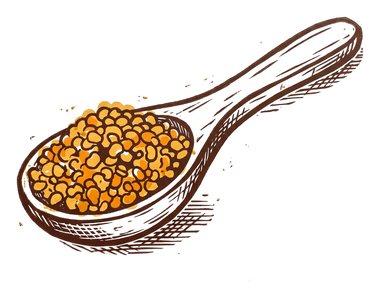
Three things bees make that are not honey
Each one has a job in the hive, and none of the jobs is being eaten by us.
Pollen. A foraging bee catches pollen in the branched hairs of her body, brushes it off with her legs, dampens it with nectar or honey and packs it into a pellet on each hind leg: two pellets a trip. Because she usually works one kind of flower at a time, the pellets come in single colors. Most are yellow, but red, purple, green and orange all occur. Beekeepers collect them with a trap at the hive door, a screen with openings just small enough to knock the pellets off as the bees squeeze through. It rarely catches more than half.2
Propolis. Bees scrape the sticky resin from leaf and flower buds, carry it home on their hind legs and mix it with wax. They use it as a builder would use caulk: to line the nest, seal cracks, narrow the entrance, and to seal up any dead intruder too big to drag out. It is soft and very sticky when warm, hard and brittle when cold. Its color, smell and makeup change with the plants nearby, so no two regions produce quite the same thing. More than 180 compounds had been identified in it by 1996.3
Royal jelly. Young worker bees make this whitish, sour, sharp-smelling paste in what is called the brood food gland and feed it to queen larvae and to the queen. It is never stored. It is eaten as fast as it is made, so the only place to find any is in the cells where new queens are being raised. Beekeepers set a colony to raising queens, then collect from each cell when the larva is about four days old. A cell should hold at least 200 milligrams. A well-run hive might give around 500 grams in a season.4
Royal jelly is never stored. It is eaten as fast as it is made.
That scarcity explains the jar. Royal jelly spoils unless it is kept cold, and one common way to sell it is mixed into honey, usually at 1 to 3 percent.4
A mix of plant resin and beeswax. Bees scrape the resin from buds and use it to line the nest, seal cracks and narrow the hive entrance. Its makeup varies with the plants nearby.
Keep asking Mel →A whitish, sour paste that young worker bees make and feed to queen larvae and the queen. Bees never store it, so it is collected from queen cells.
Keep asking Mel →With a trap at the hive entrance: a screen that knocks the pollen pellets off returning bees' legs into a tray. It rarely catches more than half.
Keep asking Mel →Three things people get wrong about wellness honey
What a label is allowed to say
The rules differ on each side of the Atlantic. Neither side leaves it to the seller.
In the United States the bright line is disease. Only a drug may legally claim to diagnose, treat, cure or prevent one. A food may make what regulators call a structure/function claim, a statement about the normal workings of the body. For ordinary foods the Food and Drug Administration says such claims rest on the food's nutritive value. A food maker does not have to notify the agency before making one, and no disclaimer is required.5 In other words, no one at the agency has to see the sentence on the jar before you do.
In the European Union it runs the other way. A health claim on a food is prohibited unless it has been authorised and appears on an official list. A vague promise of general wellbeing is allowed only if it sits next to a specific claim that is on that list.6
Getting onto the list is hard. The European Food Safety Authority reviewed 2,758 general claims between 2008 and 2011, and about one in five came through with a favourable opinion. Among the reasons it gave for the rest: the substance was not clearly identified, the claim was too vague to test, as with "energy" or "vitality," or there were no human studies with reliable measures.7
Propolis went through that process. The panel's 2010 opinion looked at eight effects claimed for it, and its summary records one difficulty that follows straight from the biology above: propolis from different places is different stuff, and the studies submitted used so many preparations and extracts that it was unclear which one the claims were about.8 The FAO's own handbook on hive products had said much the same in 1996, calling for propolis to be standardised before it was sold on a larger scale.3
In the EU, only claims that have been authorised and listed. In the US, a food may not claim to treat or prevent disease; statements about normal body function are allowed without FDA review.
Keep asking Mel →FDA does not require food makers to notify it of structure/function claims, and no disclaimer is required, so such a statement need not have been reviewed by the agency.
Keep asking Mel →No. Melvea describes what is in the jar and what the labeling rules are. It does not make health claims.
Keep asking Mel →What to look for
Read these jars the way you would read any label that is making you a promise.
Last, read the promise itself. A claim to treat or prevent an illness is not one a food may make in the United States.5 A soft word like "vitality" is exactly the kind the European reviewers found too vague to test.7 None of this tells you a jar is bad. It tells you which sentences on it have been checked by someone, and which have not.
Browse Functional honey
As an Amazon Associate, Melvea earns from qualifying purchases.
Read the ingredient list to see what was added and roughly how much, buy from a maker whose methods you trust, and treat the claims on the label as claims.
Keep asking Mel →Usually 1 to 3 percent, according to the FAO's handbook on hive products.
Keep asking Mel →Still curious about wellness honey?
Because bees make it from the resins of whatever plants are nearby. Each region and colony has its own sources, so color, smell and makeup all differ.
Keep asking Mel →It spoils unless kept cold. Mixing it into honey, usually at 1 to 3 percent, is one common way to sell it.
Keep asking Mel →before you go
Questions people ask.
What is wellness honey?
Honey with something added, most often bee pollen, propolis or royal jelly. It is a category on the shelf, not a variety of honey.
What is bee pollen?
Flower pollen that bees pack into pellets on their hind legs to carry home. Beekeepers collect it with a trap at the hive entrance.
What is propolis?
Plant resin that bees collect from buds, mix with wax and use to seal and line the hive.
What is royal jelly?
A paste made by young worker bees and fed to queen larvae and the queen. It is collected from queen cells.
Does Melvea make health claims about these honeys?
No. This page describes what is in the jar and the rules on what a label may say. It does not say what any of it does for the body.
turn the page
Other honey styles.
That is the end of this page. Go and taste something.
Sources.
- 1US Food and Drug Administration (2018). Proper Labeling of Honey and Honey Products: Guidance for Industry. February 2018. Open source
- 2Krell R (1996). Value-added products from beekeeping, chapter 3, "Pollen." FAO Agricultural Services Bulletin No. 124. Rome: FAO. Open source
- 3Krell R (1996). Value-added products from beekeeping, chapter 5, "Propolis." FAO Agricultural Services Bulletin No. 124. Rome: FAO. Open source
- 4Krell R (1996). Value-added products from beekeeping, chapter 6, "Royal Jelly." FAO Agricultural Services Bulletin No. 124. Rome: FAO. Open source
- 5US Food and Drug Administration. Structure/Function Claims. Content current as of March 28, 2024. Open source
- 6Regulation (EC) No 1924/2006 of the European Parliament and of the Council of 20 December 2006 on nutrition and health claims made on foods, Article 10. Open source
- 7European Food Safety Authority (2011). EFSA finalises the assessment of "general function" health claims. News release, July 28, 2011. Open source
- 8EFSA Panel on Dietetic Products, Nutrition and Allergies (2010). Scientific Opinion on the substantiation of health claims related to propolis and flavonoids in propolis. EFSA Journal 8(10). Abstract. Open source