

Buckwheat honey is a monofloral honey from the nectar of buckwheat (Fagopyrum esculentum), produced mainly in the northeastern United States and the Pacific Northwest.
Buckwheat honey comes from Fagopyrum esculentum — a flowering pseudocereal grown primarily in New York, Ohio, Pennsylvania, and the Pacific Northwest. Despite the name, buckwheat is botanically closer to rhubarb and sorrel than to wheat. The nectar produces the darkest, most intensely flavored honey widely available in North America — deep reddish-brown to nearly black, with molasses-forward character that polarizes tasters. Also: the one honey put through a randomized controlled trial for pediatric nocturnal cough (Paul 2007 PMID 18056558) — framed below honestly, not as a product benefit.
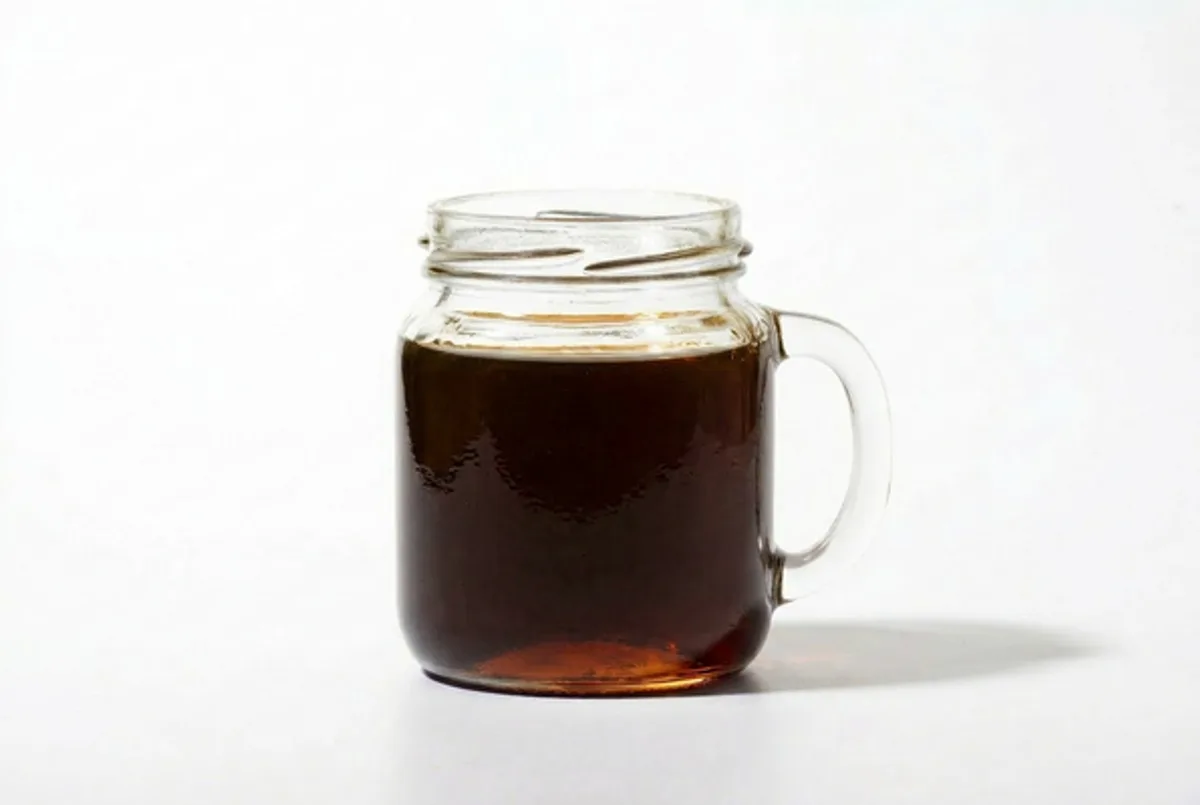
Buckwheat honey comes from the nectar of buckwheat (Fagopyrum esculentum), a flowering pseudocereal grown primarily in New York (particularly the mid-Hudson Valley), Ohio, Pennsylvania, and the Pacific Northwest (Oregon, Washington). Despite its name and historical use as a grain crop, buckwheat is botanically unrelated to wheat, barley, or any other true cereal grass. It belongs to the Polygonaceae family — the same family as rhubarb, sorrel, and dock plants.
The nectar produces the darkest, most intensely flavored honey widely available in North America, with color ranging from deep reddish-brown to nearly black. The Palate Signature places Caramel 8 as the dominant lead with Earthy 6 + Bakery 4 + Nutty 3 supporting — a bold four-family chord that reads as molasses-forward dark honey with malty undertones and subtle tannic depth. Think of it as the espresso of honey: intense, nuanced, and definitely not for those who want a neutral sweetener.
The dark color signals high polyphenol content. Puscion-Jakubik et al. (2022) [2] documented the high-phenolic-density character of dark honeys including buckwheat. The chemistry is real and well-characterized: buckwheat flowers concentrate phenolic compounds (gallic acid, p-coumaric acid, flavonoids including quercetin and kaempferol, chlorogenic acid) that transfer through nectar into the finished honey, producing both the dark color and the measurable polyphenol density. This is composition characterization, not a health-benefit claim. USDA deprecated ORAC values for health claims in 2012; in-vitro antioxidant chemistry doesn't translate to in-vivo benefit.
The Paul 2007 cough RCT — framed honestly. Buckwheat is the one honey in the catalog put through a proper randomized controlled trial for a disease state. Paul et al. (Penn State, 2007) [1] compared single-bedtime-dose buckwheat honey vs dextromethorphan (DXM, the standard OTC cough suppressant) vs no treatment in children ages 2–18 with nocturnal cough. Parents rated symptom relief on the following morning. Buckwheat honey scored best on parent-rated cough frequency, severity, sleep quality, and parent satisfaction — though the difference between buckwheat and DXM did not always reach statistical significance. The framing matters: this is a single-night, parent-reported study for minor nocturnal cough symptoms in children over 1 year old. It is NOT a finding that buckwheat replaces medical care or treats serious respiratory illness. The WHO and the American Academy of Pediatrics now recommend honey (for children ≥1 year) as a first-line option for nocturnal cough; that recommendation rests on Paul 2007 as the anchor evidence. Never give honey to infants under 12 months (botulism risk from Clostridium botulinum spores).
Crystallization is slow (typically 2–4 months at room temperature) — buckwheat's fructose-biased sugar profile (approximately 38% fructose, 33% glucose) keeps it pourable longer than glucose-heavy honeys like clover. When it does crystallize, it forms a thick, grainy, spreadable paste that many consumers prefer to liquid honey.
Buckwheat has the strongest research base in the cohort, anchored by Paul 2007 (the only RCT) and Puscion-Jakubik 2022 (composition characterization). Both are framed below honestly — research-note and composition, not product benefit.
Composition characterization. Puscion-Jakubik et al. (2022) [2] characterized the polyphenol and antioxidant profile of multiple monofloral honeys including buckwheat. The finding is that dark honey color correlates with phenolic content: buckwheat flowers concentrate phenolic compounds (gallic acid, p-coumaric acid, flavonoids including quercetin and kaempferol, chlorogenic acid) that transfer through nectar into the finished honey. The chemistry is documented, the polyphenol density is measurable, and the dark color is the visible signal of the underlying phenolic profile.
The framing matters. USDA deprecated ORAC values for health claims in 2012 — in-vitro antioxidant capacity in test-tube assays does NOT translate cleanly to in-vivo benefit. Buckwheat's measured polyphenol density is composition characterization, not an immune-support or anti-inflammatory claim. Treat the chemistry as what makes buckwheat distinct from light honeys at the compositional level; do not treat it as a health benefit.
The Paul 2007 RCT (research-note framing). Paul IM et al. (2007) [1] ran a randomized controlled trial comparing single-bedtime-dose buckwheat honey vs dextromethorphan (DXM) vs no treatment in children ages 2–18 presenting with nocturnal cough. Parents rated symptom outcomes (cough frequency, cough severity, sleep quality, satisfaction) the next morning. Buckwheat honey scored best across the parent-rated outcomes. The honey-vs-DXM comparison did not always reach statistical significance, but honey was at minimum non-inferior to DXM and outperformed no-treatment on every measure. The WHO and the American Academy of Pediatrics now recommend honey (for children ≥1 year) as a first-line option for nocturnal cough; that recommendation rests on Paul 2007 as the anchor evidence.
What Paul 2007 cannot tell us: the study tested a single bedtime dose in children with minor nocturnal cough symptoms. It does not establish honey as a treatment for serious respiratory infection, does not generalize to adults systematically, does not measure long-term effects, and does not justify use as a daily medicinal product. The honest framing: this is the one well-designed RCT for honey in a disease-state context; it documents a narrow finding (single-dose pediatric nocturnal cough relief) in a specific population (children ≥1 year). Never give honey to infants under 12 months (botulism risk).
No Manuka comparison. Buckwheat and Manuka are different honeys with different chemistry and different production traditions. Manuka's methylglyoxal (MGO) is a single-compound antibacterial mechanism specific to Leptospermum scoparium nectar; buckwheat's polyphenol density is a broad-spectrum compositional fact. Different mechanisms, different uses, different research bases. The page does not benchmark one against the other on principle.
Buckwheat's locked signature places Caramel 8 as the dominant lead — molasses-forward dark register — with Earthy 6 + Bakery 4 + Nutty 3 supporting. Four-family chord with a single overwhelming lead; the variety is concentrated and assertive. Reads polarizing because of the depth, not because of unclear chord structure.
Fruity 2 + Herbaceous 2 + Spicy 2 + Woody 2 all sit below the ≥3 threshold but contribute trace dimension to the bold four-family lead. Floral stays at 0 (dark honey, no floral character). Buckwheat is structurally a Caramel-dominated chord with broad low-level support.
Despite the name, buckwheat (Fagopyrum esculentum) is botanically unrelated to wheat. It belongs to Polygonaceae — the rhubarb-sorrel-dock family. The dicot phytochemistry produces a unique polyphenol profile that directly influences the flavor and color of the honey. The plant has one of the shortest growing cycles of any crop (30 days seed-to-bloom, 70–90 days to maturity), making it valuable as a cover crop and climate-adaptive rotation. Modern sustainable farmers are reviving buckwheat as a cover crop in organic systems — which is gradually rebuilding the bee forage base after decades of post-1918 decline.
Buckwheat is the darkest commonly available North American honey — deep reddish-brown to nearly black, sometimes described as 'almost as dark as maple syrup.' The Palate Signature locks Caramel 8 as the dominant lead with Earthy 6 + Bakery 4 + Nutty 3 supporting. Molasses-forward, malty, with subtle tannic depth. The flavor is polarizing in the best way: some people love it the first time they try it; some people don't. There is no neutral position. The chemistry is real, the depth is measurable, and the variety has earned a serious place in American specialty honey for tasters who want intensity.
Paul et al. (Penn State, 2007) tested buckwheat honey vs dextromethorphan vs no treatment for pediatric nocturnal cough in a proper randomized controlled trial. Buckwheat outperformed no-treatment on every parent-rated outcome; honey-vs-DXM differences were not always statistically significant but trended in honey's favor. WHO and American Academy of Pediatrics now recommend honey for children ≥1yr with nocturnal cough on the strength of this evidence. The finding is narrow (single-dose, parent-rated, pediatric, ≥1yr only) and does not justify broader medicinal claims — but it's a real RCT, and that's worth knowing.
Commercial buckwheat production in North America concentrates in a few regions: New York (particularly the mid-Hudson Valley), Ohio, Pennsylvania, and the Pacific Northwest (Oregon, Washington). These regions have the cool-season climate and soil conditions buckwheat prefers. Canada also produces significant buckwheat, particularly in Manitoba and Ontario.
Production history. Buckwheat was a major American commodity crop in 1918, with over 1 million acres planted nationally. The variety declined sharply from the 1950s through the 1980s as wheat, corn, and soy subsidies redirected agricultural land. By 2000, US buckwheat acreage had bottomed at under 25,000 acres — a 95% decline. The 2015–2026 period has seen modest recovery to 50,000–90,000 acres annually as cover-crop interest and specialty-food demand returned. Still far below historical levels, but the trend is reversing — and that recovery is rebuilding the bee forage base for late-summer/early-fall production.
Beekeepers in these regions have long understood buckwheat honey's market value. A single strong buckwheat bloom can yield 20–40 pounds of honey per hive — dark, intense, and reliably premium-priced. Unlike clover or wildflower (which are scattered across regions), buckwheat has become almost a signature regional product: New York buckwheat honey is recognized as a distinct, valued product with local identity.
Verified producer anchors: Dutch Gold (Best Value — workhorse American buckwheat, widely available), GloryBee (Best Organic — certified organic + raw from Oregon, darker and more flavor-forward), Catskill Provisions (New York origin — small-batch raw from upstate NY, single-origin). For NY/PA single-state product, the Empire State Honey Producers Association ('Buy Local' directory) and the Pennsylvania State Beekeepers Association are the discovery channels for small producers operating in historic American buckwheat-belt regions but rarely reaching national retail.
As an Amazon Associate, Melvea earns from qualifying purchases.
Buckwheat tastes like buckwheat. There is no metaphor that gets closer. Molasses, dark caramelized sugar, mineral earthiness, toasted-nut depth, a faint barnyard edge. The Palate Signature lands Caramel 8 as the dominant lead with Earthy 6 + Bakery 4 + Nutty 3 supporting. Some people love it the first time they try it. Some people don't. There is no neutral position. Worth trying once and deciding for yourself.
Paul IM et al. (2007, Archives of Pediatrics & Adolescent Medicine, PMID 18056558) tested single-bedtime-dose buckwheat honey vs dextromethorphan (DXM) vs no treatment in children ages 2–18 with nocturnal cough. Parents rated symptom outcomes (cough frequency, severity, sleep quality, satisfaction) the next morning. Buckwheat honey scored best on the parent-rated outcomes — outperforming no-treatment on every measure, and trending favorably vs DXM (though honey-vs-DXM differences did not always reach statistical significance). The WHO and the American Academy of Pediatrics now recommend honey for children ≥1yr with nocturnal cough on this evidence. Important caveats: this is a single-night, parent-reported study for minor nocturnal cough symptoms; it does not establish honey as a treatment for serious respiratory illness; never give honey to children under 12 months (botulism risk).
Buckwheat is documented in food-science literature as carrying high polyphenol content relative to light honeys — Puscion-Jakubik 2022 and others characterize the phenolic compounds (gallic acid, p-coumaric acid, flavonoids, chlorogenic acid) that buckwheat flowers concentrate and transfer into the honey. That is composition characterization — real chemistry, measurable phenolic density. The framing matters. USDA deprecated ORAC values for health claims in 2012; in-vitro antioxidant capacity in test tubes doesn't translate cleanly to in-vivo benefit. Buckwheat's polyphenol density makes it compositionally distinct from light honeys; it doesn't make the honey a health intervention.
No — not as a clean rule. Darker honeys do tend to carry more phenolic compounds than lighter ones, and the composition pattern is documented across honey-research literature. But the broader claim that color alone predicts wellness benefit oversimplifies a few things: phenolic content varies widely within the dark-honey category; antioxidant capacity in vitro does not translate cleanly to health outcomes in vivo; and the comparison only makes sense against specific lighter honeys. Buckwheat carries strong antioxidant chemistry. That is a specific finding about a specific variety, not a category claim about every dark honey on the shelf.
Three primary anchors. Dutch Gold (Best Value workhorse American buckwheat, widely available). GloryBee (Best Organic — certified organic, raw, minimally processed from Oregon). Catskill Provisions (New York Origin — small-batch raw, single-origin from upstate New York). For single-state NY and PA discovery, the Empire State Honey Producers Association (eshpa.org) 'Buy Local' directory and the Pennsylvania State Beekeepers Association serve historic American buckwheat-belt regions where small-scale producers continue to operate.
Bold partners. Cooking and baking where you want dark sugar character — gingerbread, dark chocolate cakes, molasses cookies, rye breads. BBQ glazes and marinades where the molasses pairs with smoke and char. Cheese boards with aged gouda, blue cheese, sharp cheddar. Pancake topper when you want the syrup-replacement effect. It is NOT a tea honey — it overwhelms tea. It is NOT a delicate-pastry honey — it dominates. The rule is match boldness to boldness. If your dish wants quiet sweetness, reach for clover or alfalfa. If your dish wants depth, this is the jar.
Buckwheat flowers contain high levels of phenolic compounds — the same compounds that give the honey its dark reddish-brown to black color. These phenolics transfer directly to the nectar and concentrate in the finished honey. Dark color is a visual marker of high phenolic content. Buckwheat is one of the darkest commonly-available honeys because it carries one of the richest phenolic profiles among North American monoflorals.
Buckwheat crystallizes slowly (2–4 months at room temperature) due to its fructose-biased sugar profile (~38% fructose, 33% glucose). When it crystallizes, it forms a thick, grainy, spreadable paste that many consumers prefer to liquid form. The phenolic chemistry remains stable; nutritional content is unchanged. To re-liquefy, place the sealed jar in warm water for 15–20 minutes (max 40–45°C; never microwave, never above 50°C — heat degrades phenolics). Store at room temperature in a sealed container away from direct sunlight.
Chromatographic + physicochemical characterization of buckwheat honey.
Survey of phenolic compound content + in-vitro antioxidant capacity across multiple monofloral honey varieties including buckwheat. Documents the dark-honey -> high-polyphenol correlation.
Blinded randomized controlled trial. 105 children aged 2-18 years with URI-related cough of <7 days duration were randomized to one of three arms: a single bedtime dose of buckwheat honey, honey-flavored dextromethorphan (DM), or no treatment. Parents completed validated 7-point Likert questionnaire about cough frequency, severity, bothersome nature, and child + parent sleep quality on the symptom night and the treatment night.
Spotted in the wild
From shelves, kitchens, and markets. Add yours — we review every submission.
No photos yet.
Be the first to submit a photo of Buckwheat honey— help build the encyclopedia.
Submit a Buckwheatphoto →Verified buckwheat honey producers in our network.
San Diego, California
San Diego Honey Company is a woman-owned, small-batch honey brand founded in 2011 and based in San Diego, California. Th...
Brooklyn, New York
Goshen Honey (also known as Goshen Honey DBA Amish Honey) is a New York-based small business that sources rare, raw, unf...
Little Falls, Minnesota
Thorne Honey Farm is a small raw honey producer based in Little Falls, Minnesota, operated by Thomas Thorne. The farm pr...
McKinney, Texas
Nature Nate's Honey Co. is the #1 branded honey company in the United States, headquartered in McKinney, Texas. Founded ...
Oregon
Sheridan, Illinois
Y.S. Eco Bee Farms (also known as Y.S. Organic Bee Farms) is a national, family-rooted honey brand headquartered in Sher...
Are you an buckwheat beekeeper?
Claim Your Farm