


Lehua is the red flower of the ʻōhiʻa, the tree that holds Hawaiʻi's native forests together and is often the first to grow on new lava. Its honey sets pale and creamy, with notes of butterscotch and brown sugar. The tree now faces a fungal disease that arrived only recently, and the islands are working hard to contain it.
Updated
Lehua's plaid. The ground is its color, estimated from written descriptions. The lines are floral and bakery, the flavors that lead it.
Hawaiʻi's most important native tree.
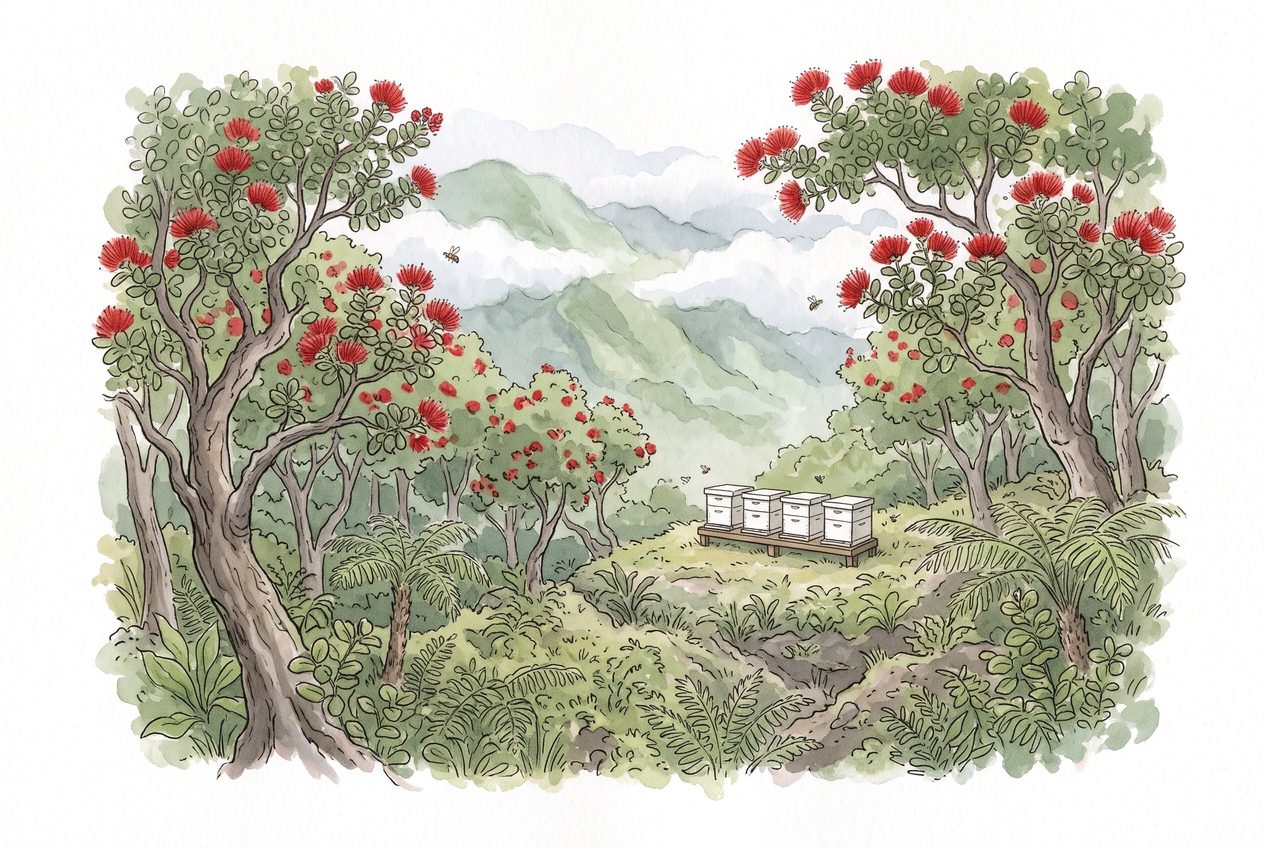
It takes every kind of ground the islands offer. Forests dominated by ʻōhiʻa grow both on lava about 300 years old on Hawaiʻi Island and on soils about 4.1 million years old on Kauaʻi.3
Hawaiʻi's most abundant and ecologically important native tree, Metrosideros polymorpha. Its flower is the lehua.
Keep asking Mel →Yes. It is often the first tree to grow on new lava flows.
Keep asking Mel →A red puff of stamens, and a story.
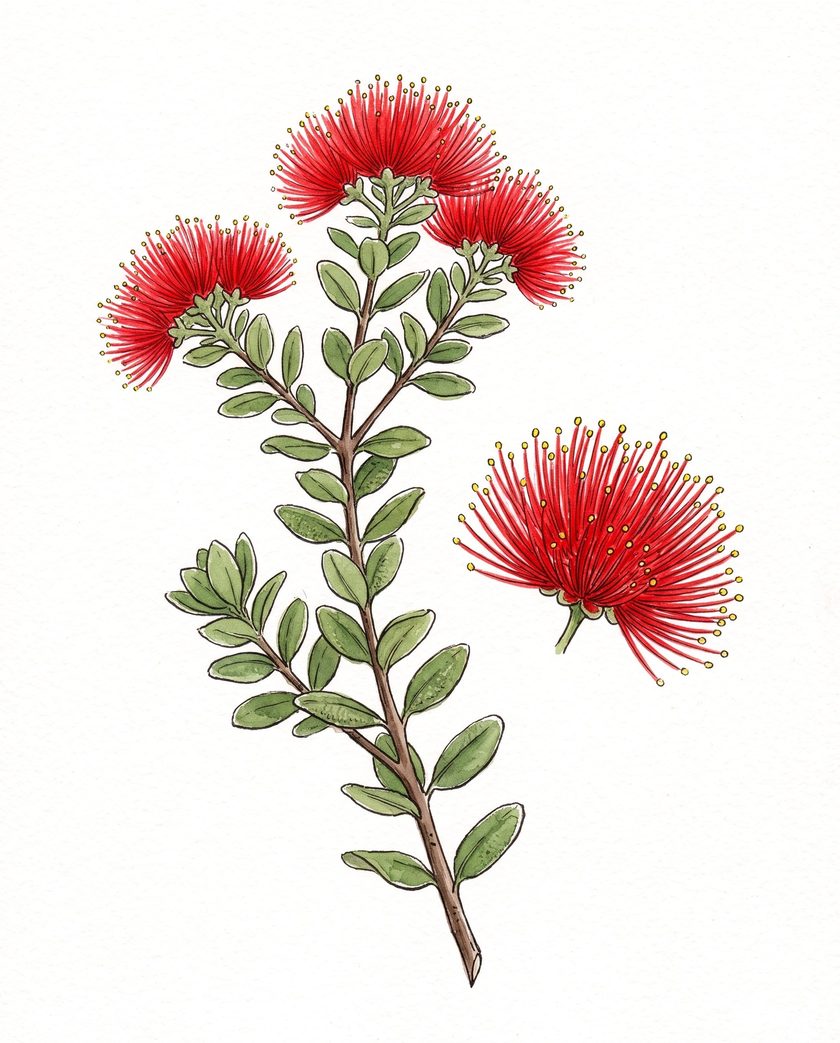
Lehua is the red, fluffy flower of the ʻōhiʻa, known as Pele's flower. In the legend, ʻŌhiʻa and Lehua were lovers. Pele, the volcano goddess, desired ʻŌhiʻa and was refused; Lehua became the flower on the ʻōhiʻa tree, uniting the two forever. Pick a lehua blossom, it is said, and rain will fall: the tears of the parted lovers.2
Pick a lehua blossom, the saying goes, and the rain will come.
ʻŌhiʻa and Lehua were lovers. Pele desired ʻŌhiʻa and was refused, and Lehua became the flower on the ʻōhiʻa tree, uniting them.
Keep asking Mel →Because it takes so many forms. Its leaves alone range from bare to heavily haired.
Keep asking Mel →A late arrival to an old forest.
Honey bees are not native to Hawaiʻi. The first hive came from California in 1857, after earlier attempts to ship bees around Cape Horn from New England failed. Hawaiʻi shipped its first commercial honey in 1894, and one company, the Sandwich Island Honey Company, at one time ran 10,000 colonies.6
Beekeepers noticed the ʻōhiʻa early. A 1952 university bulletin noted that it covers large areas of Hawaiʻi Island and grows at higher elevations on most of the islands, and that its honey is light amber and of good flavor.6
In 1857, when the first hive arrived from California.
Keep asking Mel →No. A 1952 University of Hawaiʻi bulletin already described ʻōhiʻa honey as light amber and of good flavor.
Keep asking Mel →Rapid ʻōhiʻa death, and the work to stop it.
A disease called rapid ʻōhiʻa death is killing ʻōhiʻa on Hawaiʻi Island.2 In 2018 scientists described the two fungi behind it as new species, Ceratocystis lukuohia and C. huliohia. Both appear to be clonal, recently introduced strains.7 Of the two, C. lukuohia appears to be the more important, and researchers have proposed calling the disease Ceratocystis wilt of ʻōhiʻa.8
A disease caused by two fungi, Ceratocystis lukuohia and C. huliohia, that kills ʻōhiʻa trees on Hawaiʻi Island.
Keep asking Mel →Fast lab tests to detect the fungi, a state quarantine on moving ʻōhiʻa wood between islands, and steam treatment of logs.
Keep asking Mel →A honey from the Kaʻu highlands.
Floral: gentle floral — the defining note
Tap a family to read its note.
Lehua measures about 68 mm (Light Amber, estimated).
Clover measures about 26 mm (White, estimated).
Complex and not too sweet, with notes of butterscotch, butter and brown sugar.
Keep asking Mel →It sets naturally into a soft, creamy, yellow-white honey.
Keep asking Mel →Its flavors blend into the cup.
Lehua honey pairs well with coffee, where its butterscotch notes blend into the cup.2
Lehua + coffee. Butterscotch meets roast.
In coffee, spread on toast, or with banana bread and fresh pineapple.
Keep asking Mel →Look for an island and a beekeeper.
Good lehua honey names its island and district and a beekeeper. Expect it set and pale; that is its nature.
Below are the jars Melvea has been able to score.
As an Amazon Associate, Melvea earns from qualifying purchases.
Look for a named island and district, such as Kaʻu on Hawaiʻi Island, and a beekeeper.
Keep asking Mel →Each jar gets one score built from three parts: flavor counts for 50%, origin for 30% and purity for 20%. The three bars on every jar card show how it did on each.
Keep asking Mel →Honey from the red lehua flower of the ʻōhiʻa, Hawaiʻi's keystone native tree.
Keep asking Mel →Creamy, with butterscotch, butter and brown sugar notes.
Keep asking Mel →Each jar gets one score built from three parts: flavor counts for 50%, origin for 30% and purity for 20%.
Keep asking Mel →Complex and not overly sweet, with notes of butterscotch, creamery butter and brown sugar.
It sets naturally into a soft yellow-white, creamy honey.
Mostly from the Kaʻu District of Hawaiʻi Island.
ʻŌhiʻa is the tree; lehua is its red flower.
A disease caused by two recently introduced Ceratocystis fungi that kills ʻōhiʻa trees.
In 1857, from California.
Tasted a lehua jar? Rate it in one tap.
Find your jar →Spotted in the wild
From shelves, kitchens, and markets. Add yours — we review every submission.
No photos yet.
Be the first to submit a photo of Lehua honey— help build the encyclopedia.
Submit a Lehuaphoto →Verified lehua honey producers in our network.
Captain Cook, Hawaii
Single-origin Hawaiian honey from the Big Island.
Kailua-Kona, Hawaii
Kona coast honey from sustainable hives in Hawaii's premier honey-producing region.
Asheville, North Carolina
Blue Ridge Mountain honey from local Appalachian apiaries.
Waialua, Hawaii
Aloha Honey Farm is a family-owned Hawaiian apiary based in Waialua, Oahu, Hawaii, producing 100% raw, unfiltered honey ...
Maine
Maine-based raw and varietal honeys including the Maine Beekeeper wildflower line.
Are you an lehua beekeeper?
Claim Your Farm