

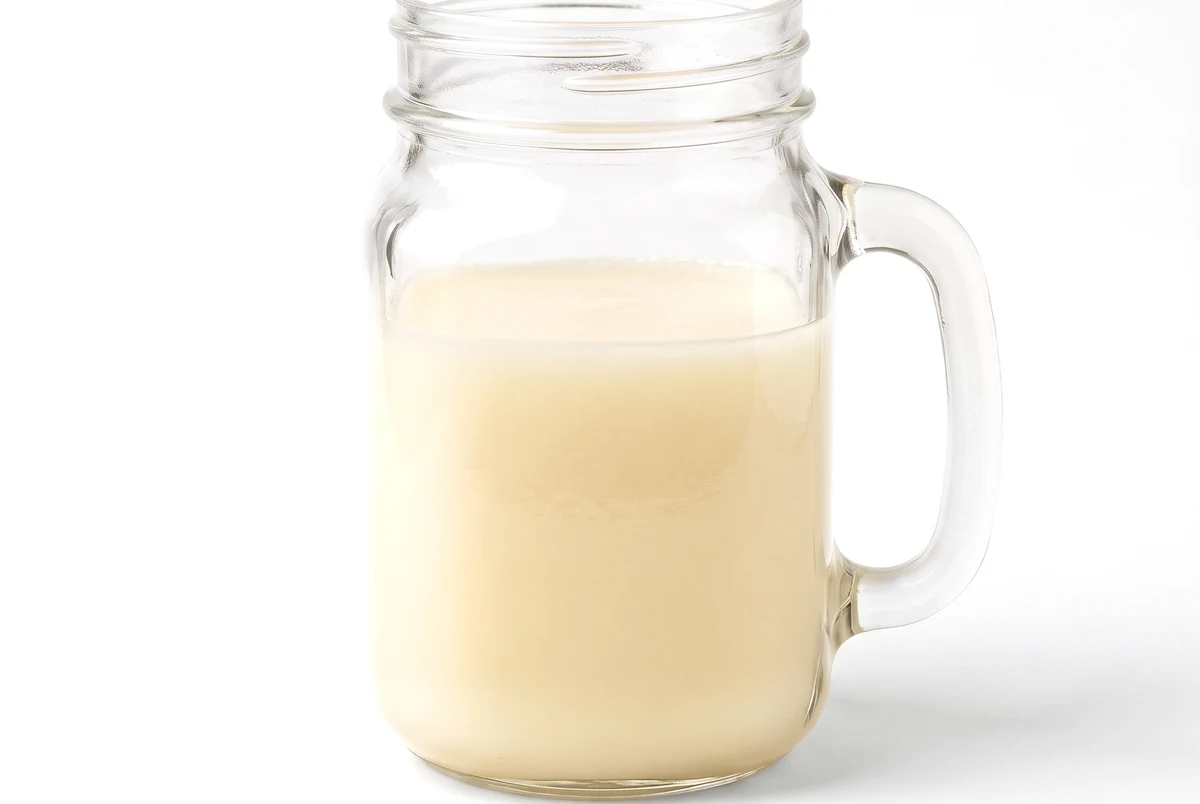
Every kiawe tree in Hawaii is said to descend from one seedling planted in a Honolulu churchyard in 1828. Its descendants now cover the dry leeward coasts, and in the forest at Puako the bees work almost nothing else. The honey comes out white.
Updated
Kiawe's plaid. The ground is its color, estimated from written descriptions. The lines are floral, fruity and nutty, the flavors that lead it.
Where the rain stops, the kiawe starts.
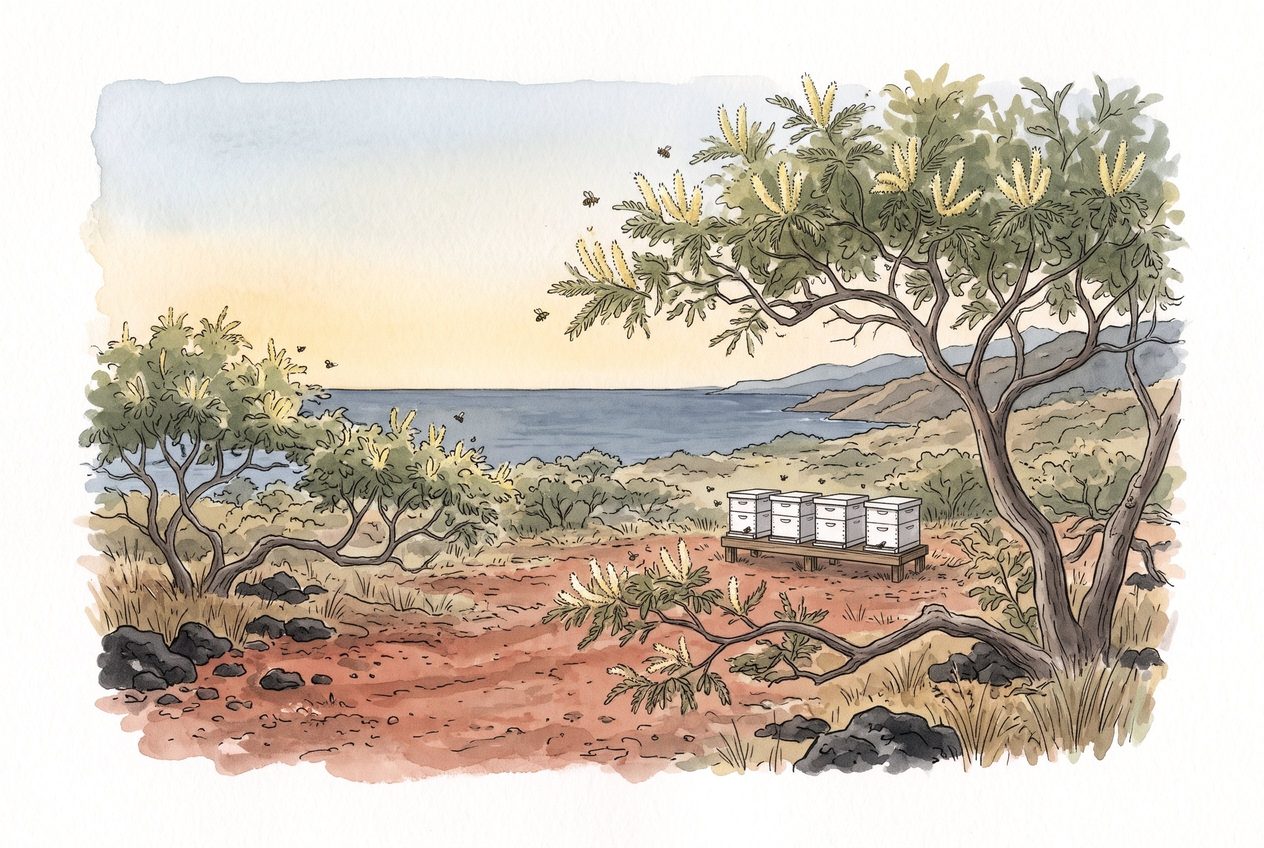
Kiawe is most common on Hawaii's leeward coasts, where rain runs 10 to 30 inches a year. More than 150,000 acres of dry kiawe forest in Hawaii descend from a single tree planted in 1828.1
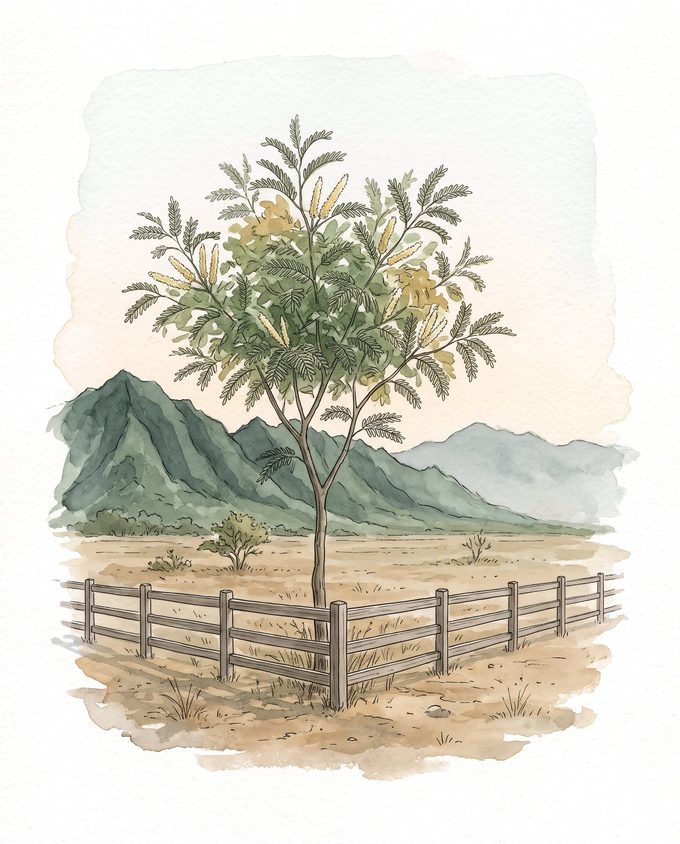
On Molokai, a beekeeper whose land is "nothing but kiawe" credits the tree for his white honey, which took three first places at the Hawaiian Natural Honey Challenge in 2013.4
From the dry leeward coasts of the Hawaiian Islands, including a 1,000-acre kiawe forest at Puako on the Big Island and kiawe land on Molokai.
Keep asking Mel →At Puako, so few other plants grow that the bees gather kiawe nectar almost exclusively.
Keep asking Mel →A Peruvian tree on a volcanic shore.
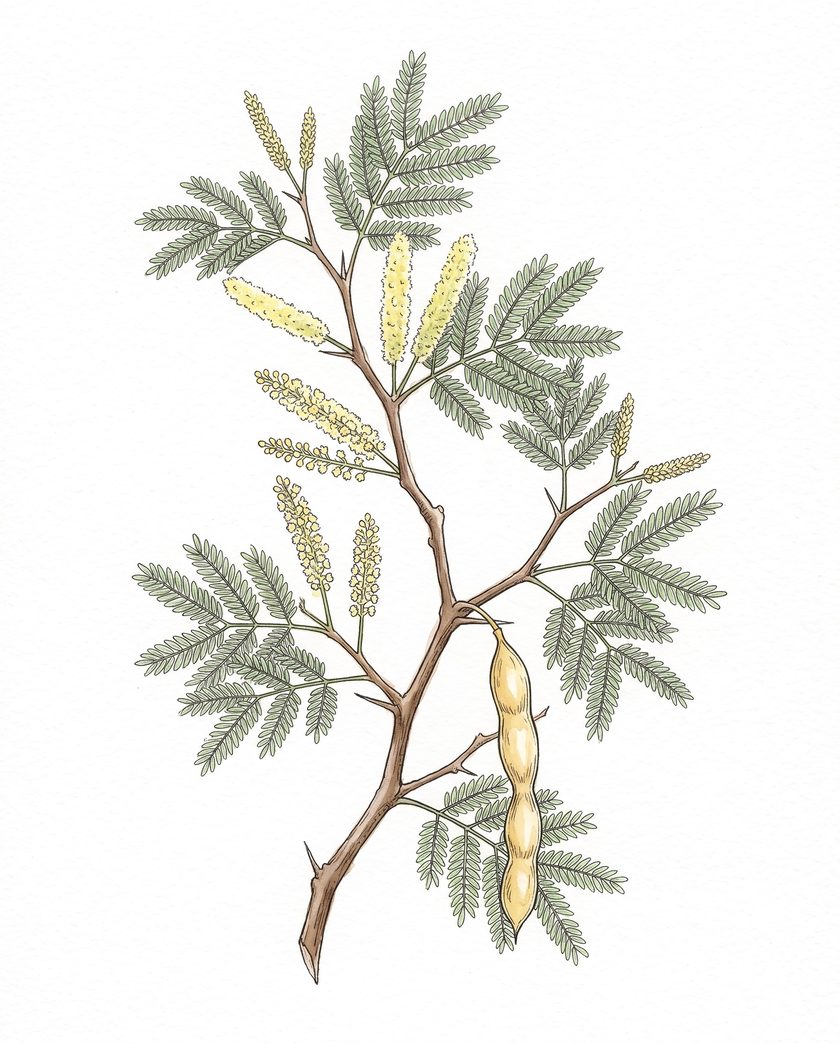
Its flowers are small and numerous, packed into pale yellow spikes 3 to 4 inches long, and insects pollinate them. A tree starts flowering at three or four years old and can bloom at any time of year, often twice. The main flowering runs January to March, with a second round in September and October after a wet summer.1
A kiawe tree can flower at any time of year, often twice.
Pods ripen about six months after the flowers: yellowish beans up to 8 inches long, holding 10 to 20 seeds in a sticky, sugary pulp. Pods and seeds make nutritious fodder, and the hard, heavy wood burns as fuel and charcoal.1
It can flower any time of year, often twice. The main bloom is January to March, with a second in September and October after a wet summer.
Keep asking Mel →To the drier parts of Peru, Colombia and Ecuador, especially near the coast.
Keep asking Mel →From a churchyard in 1828 to the islands' dry plains.
By 1840 that tree's offspring were Honolulu's main shade trees and were spreading to the dry leeward plains of every island.1 The first hive of honey bees came from California in 1857,6 and Hawaii came to export about 200 tons of kiawe honey a year.2 In 1935 the islands shipped more than 200 tons of it.1 A Honolulu magazine of 1920 reckoned the tree's descendants covered about 90,000 acres of barren land and yielded about 30,000 cords of firewood a year.7
More than 150,000 acres of kiawe forest descend from one tree planted in 1828.
The same tree is now an invader. Kiawe reaches groundwater that native plants cannot, and it has spread through extensive dry lowlands on the Big Island.8 As a nitrogen-fixing tree that taps groundwater, it changes how the coastal ecosystems it invades work.9 Where it has spread, it is also valued in some places for shade, cattle fodder, fuel, fence posts and honey.10
The honey has its own pressures. Varroa mites reached Oahu in 2007 and the Big Island by 2008, and small hive beetles, which tunnel through comb and can leave honey fermenting, were confirmed near Hilo in 2010.11 A fire in 2007 burned nearly half of the Puako forest, though the trees have come back, and new development presses on what is left.3
Father Alexis Bachelot planted a seed from a Peruvian tree in the royal garden at Paris in the Catholic mission grounds in Honolulu in 1828.
Keep asking Mel →Yes. It taps groundwater native plants cannot reach and has spread through extensive dry lowlands, though it is still valued for shade, fodder, fuel and honey.
Keep asking Mel →A honey that sets fast.
Hawaii's experiment station analyzed algaroba honey in 1908 and found it nearly water white, with a delicate flavor suited to the table. It solidifies soon after extraction; the sample held 17 percent water.12 A 1952 University of Hawaii bulletin put it more exactly: pure kiawe honey is white to water-white and usually granulates within three or four weeks of being stored in the comb. The same bulletin rated its flavor above Java plum and eucalyptus honey.6
That speed sets the beekeeper's clock. Harvest too early and the honey can ferment; too late and it crystallizes in the comb, and getting it out then takes heat.13 At Puako the honey is taken fully ripe but before it sets, and the owners describe it by its creamy texture, white color and delicate tropical flavor.3
Kiawe's relatives behave the same way. In central Argentina, Prosopis honey measured about 7.9 mm on the Pfund color scale, white-water, with 37 percent glucose, and it granulated faster than the yellow starthistle honey studied beside it.14 Slow Food lists white kiawe honey on its Ark of Taste, its catalogue of foods at risk of being lost.13 Melvea's Palate Signature reads it as floral first, with fruity and nutty notes behind.
Floral: delicate and light, the lead in Melvea's reading
Tap a family to read its note.
Its producers describe a creamy texture, white color and delicate tropical flavor; Melvea reads it as floral first, with fruity and nutty notes.
Keep asking Mel →It crystallizes fast: a 1952 University of Hawaii bulletin says pure kiawe honey usually granulates within three or four weeks in the comb, so beekeepers harvest it ripe but before it sets.
Keep asking Mel →Where a gentle, spreadable honey fits.
Kiawe's soft texture and light flavor suit plain, fresh foods that let it show.
Kiawe + fresh ricotta. Cream on cream.
Spread it on warm toast, or spoon it over fresh ricotta, ripe papaya or plain yogurt.
Keep asking Mel →Hawaii and kiawe on the label.
As an Amazon Associate, Melvea earns from qualifying purchases.
Look for kiawe and the island on the label, plus a named beekeeper. A white, creamy set is normal.
Keep asking Mel →Each jar gets one score built from three parts: flavor counts for 50%, origin for 30% and purity for 20%. The three bars on every jar card show how it did on each.
Keep asking Mel →Honey from Prosopis pallida, a South American mesquite planted in Hawaii in 1828.
Keep asking Mel →On Hawaii's dry leeward coasts, including the kiawe forest at Puako on the Big Island and on Molokai.
Keep asking Mel →Creamy, white and delicate; floral first, with fruity and nutty notes.
Keep asking Mel →Each jar gets one score built from three parts: flavor counts for 50%, origin for 30% and purity for 20%.
Keep asking Mel →Its producers describe a creamy texture, white color and delicate tropical flavor; Melvea reads it as floral first, with fruity and nutty notes.
It starts nearly water white and usually granulates within three or four weeks into a pearly, creamy set, which is its natural state.
In Hawaii, on the dry leeward coasts, including Puako on the Big Island and Molokai.
It can flower any time of year; the main bloom is January to March.
Father Alexis Bachelot planted the first tree in the Catholic mission grounds in Honolulu in 1828.
Yes. Kiawe is Prosopis pallida, a mesquite.
Tasted a kiawe jar? Rate it in one tap.
Find your jar →Spotted in the wild
From shelves, kitchens, and markets. Add yours — we review every submission.
No photos yet.
Be the first to submit a photo of Kiawe honey— help build the encyclopedia.
Submit a Kiawephoto →Verified kiawe honey producers in our network.
Waialua, Hawaii
Aloha Honey Farm is a family-owned Hawaiian apiary based in Waialua, Oahu, Hawaii, producing 100% raw, unfiltered honey ...
Keaau, Hawaii
Are you an kiawe beekeeper?
Claim Your Farm